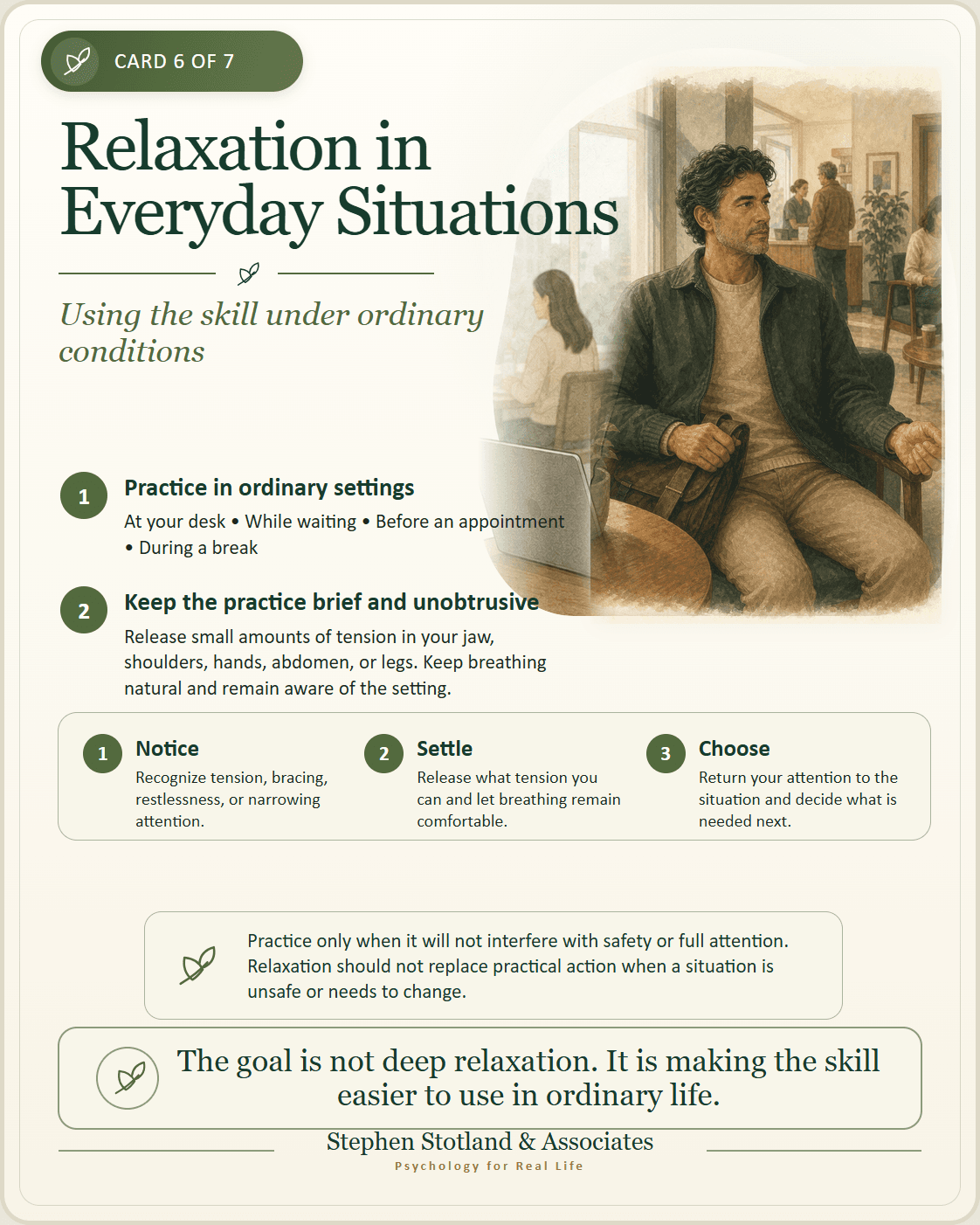
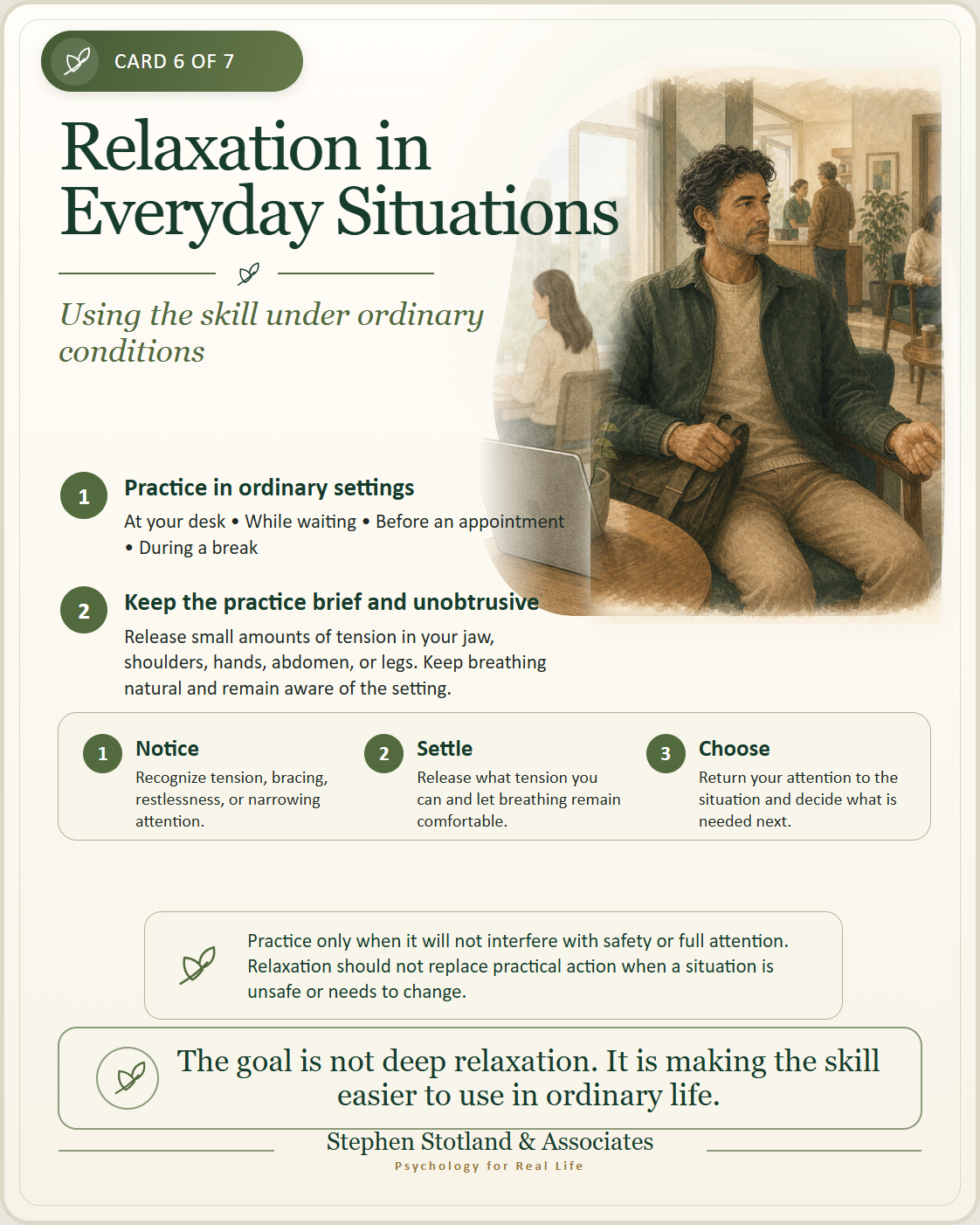
Using the skill under ordinary conditions
Relaxation in Everyday Situations is the fourth stage of Applied Relaxation Training.
In Shortened Relaxation, you practiced releasing unnecessary tension in progressively less time. You will now begin using those shorter forms in ordinary settings rather than depending on silence, privacy, closed eyes, or ideal conditions.
The goal is not deep relaxation. It is to make the skill more portable and easier to use while daily life is continuing around you.
Before you begin
Start in ordinary situations that are safe and only mildly distracting.
Examples include:
- sitting in a waiting room;
- riding public transit as a passenger;
- taking a break at work;
- sitting in a café or park;
- waiting for an appointment;
- sitting at your desk before beginning a task; or
- attending a routine meeting when the practice will not interfere with participation.
Keep your eyes open when appropriate. Remain aware of the setting and continue to meet the demands of the situation.
Do not practice while driving, cycling in traffic, crossing streets, operating machinery, supervising safety, or doing anything else that requires your full attention.
The basic method
Use one of the shortened practices you have already learned.
A simple version is:
- Notice where you are holding tension.
- Let your jaw loosen and your shoulders lower.
- Soften your hands, abdomen, and legs where possible.
- Let breathing remain natural and comfortable.
- Use your cue word if helpful.
- Pause briefly and notice any change.
- Return your attention to what is happening around you.
The practice may take one or two minutes, or only a few seconds.
You do not need to work through every part of the body. Focus on the areas where you most often notice unnecessary tension.
Keeping the practice unobtrusive
Everyday relaxation usually involves releasing effort rather than deliberately tensing muscles.
You might:
- unclench your jaw;
- let your tongue rest;
- lower your shoulders slightly;
- loosen your grip;
- let your hands rest;
- stop bracing your abdomen;
- allow your legs to feel supported; or
- feel your feet against the floor.
Use small movements that fit the setting. No one else needs to know that you are practicing.
If you feel self-conscious, begin in a setting with more privacy or use only one simple action, such as releasing your hands or shoulders.
Working with distraction
Sounds, movement, other people, and interruptions are part of this stage.
You do not need to block them out. Notice the distraction, return briefly to the area you are releasing, and then reconnect with the situation.
If the setting is too distracting, choose an easier one next time. Moving back to a quieter setting is an adjustment, not a failure.
The skill should become simpler under ordinary conditions, not more forceful.
A gradual practice plan
Begin with one or two planned settings that feel manageable.
For example:
- practice for one minute while sitting quietly with your eyes open;
- practice with ordinary background noise;
- practice while another person is nearby;
- practice in a familiar public setting; and
- practice during a routine daily activity that does not require your full attention.
You can move forward, remain with one setting, or return to an easier setting as needed.
Continue using longer Active, Passive, or Shortened Relaxation practices periodically. Everyday practice adds flexibility; it does not replace the earlier methods.
Using Notice → Settle → Choose
The brief reminder is:
Notice → Settle → Choose
Notice
Recognize tension, bracing, restricted breathing, restlessness, or narrowing attention.
Settle
Release what tension you can, let breathing remain comfortable, and use your cue word if helpful.
“Settle” does not mean becoming completely calm. It means reducing unnecessary effort and noticing whether anything shifts.
Choose
Return your attention to the situation and decide what is needed next.
Often the choice will simply be to continue with what you were doing. At other times, you may need to speak, wait, change position, take a break, solve a problem, or use another strategy.
Common difficulties
“There is too much going on.”
Use a shorter practice and focus on one area, such as your jaw, shoulders, or hands. Try a less distracting setting next time.
“I forget to practice.”
Choose one or two regular situations as reminders—for example, sitting down at your desk, waiting for an appointment, or beginning a break.
“I feel self-conscious.”
Keep the movements small and use release rather than deliberate muscle tension. You may also choose a setting with more privacy while the skill becomes familiar.
“I do not feel very relaxed.”
Look for a modest change: less gripping, a softer jaw, lower shoulders, or a brief pause. Deep relaxation is not required in an everyday setting.
“The practice distracts me from what I am doing.”
Stop and return your full attention to the situation. Practice at another time or in a setting with fewer demands.
Important reminders
- Keep breathing natural, comfortable, and unforced.
- Keep your eyes open when the setting requires it.
- Use small, comfortable movements.
- You may pause, shorten, modify, or stop.
- Return your attention fully to the situation when needed.
- Do not practice during activities requiring full attention.
Relaxation should not be used to remain in a situation that is unsafe, abusive, coercive, or otherwise unacceptable. Protection, leaving, setting a boundary, or asking for help may be more important.
If you feel faint, unreal, shut down, or disconnected from yourself or your surroundings, further relaxation may not be helpful. Look around, feel your feet against the floor, move gently, engage your senses, or contact a supportive person.
Discuss significant or recurring difficulties with your clinician.
The goal is not deep relaxation. It is making the skill easier to use in ordinary life.