Returning to the Present
Reconnect with what is actually happening when thoughts, feelings, sensations, memories, or urges begin to take over.
Strong thoughts, feelings, sensations, memories, or urges can narrow awareness until they feel like the whole reality. Returning to the present means widening awareness again: where you are, what is actually happening, and what choices you still have.
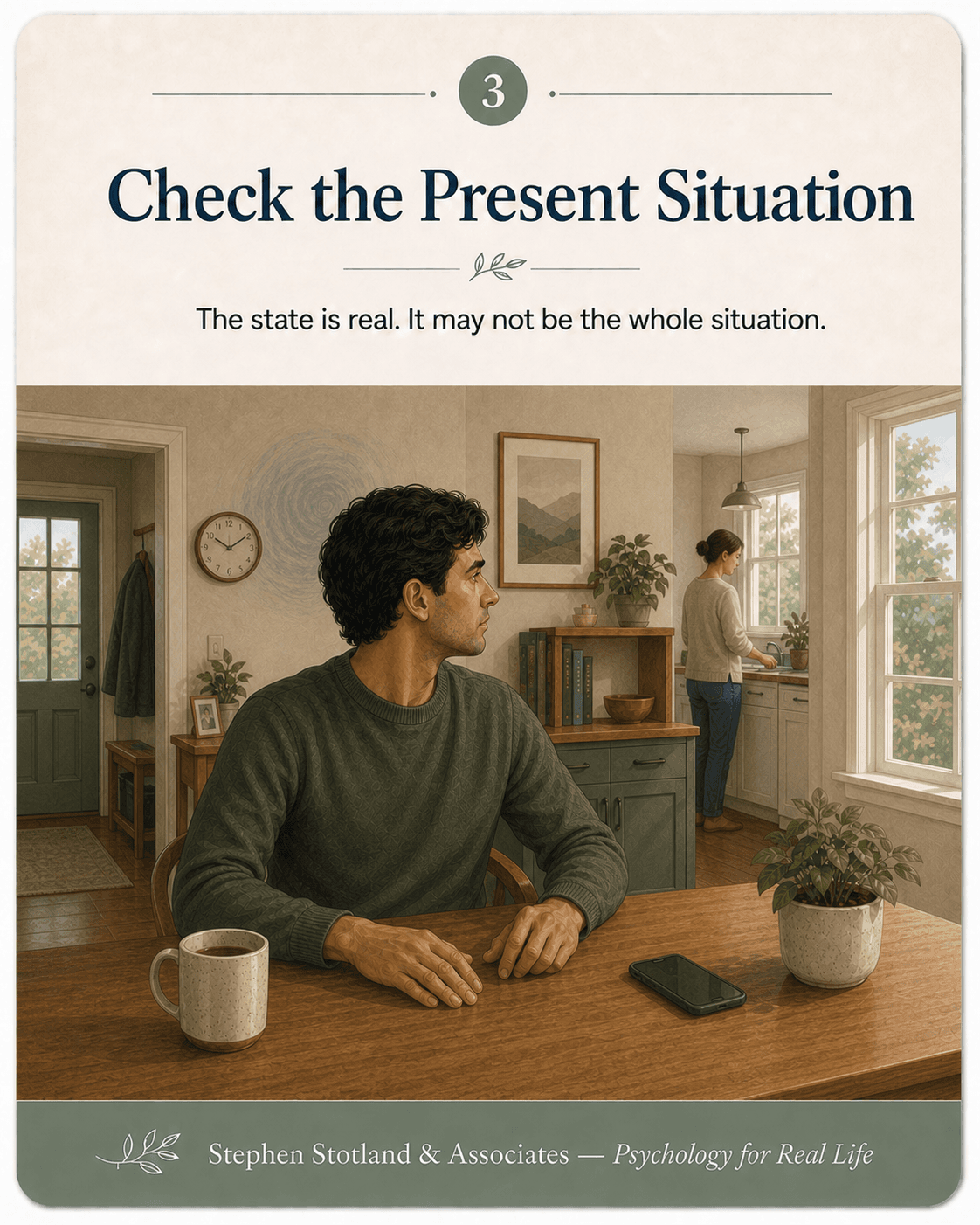
The state is real. It may not be the whole situation.
The four steps
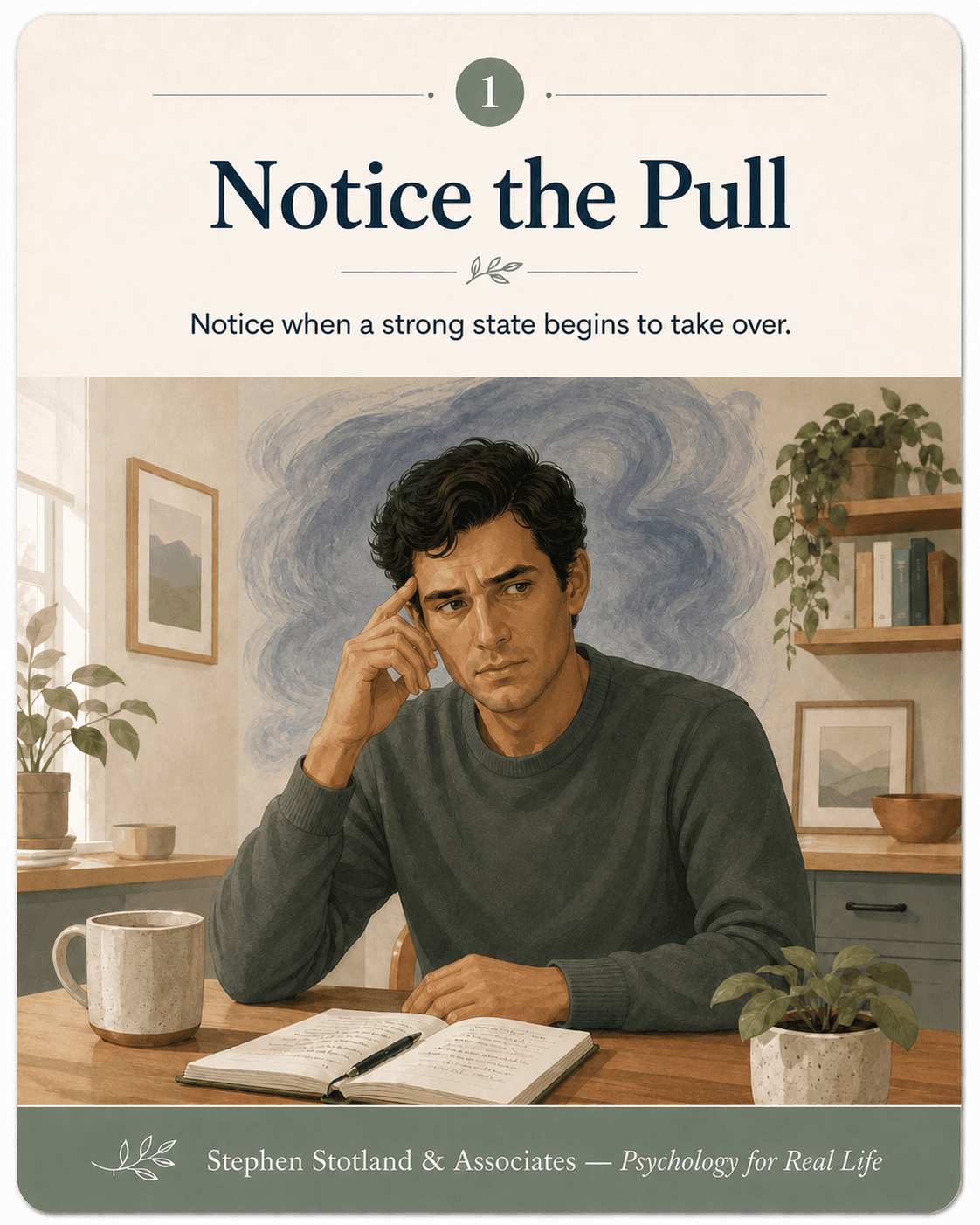

Notice the Pull
Notice when a strong internal state is beginning to dominate awareness.
Notice the early signs
A strong state may be taking over when:
- attention narrows and the surroundings begin to fade;
- the same thought or mental scene repeats;
- everything starts to feel urgent;
- you feel driven to escape, consume, attack, check, seek reassurance, or act;
- you feel trapped, unsafe, detached, unreal, or mentally elsewhere; or
- it seems as though nothing else matters.
Make it personal
I know I am being pulled away from the present when…
Complete the sentence with two or three signs you recognize. You do not need to understand the state before recognizing that it is taking over.
If you notice only afterward
Identify one sign when you review the moment. Noticing the pattern later is still useful and can help you recognize it sooner next time.
If something requires immediate action because of current danger, medical need, or another practical problem, prioritize safety and appropriate help.
Reconnect with Here and Now
Use your surroundings, body, movement, or another person to reconnect with what is here now.
Choose one or two ways to reconnect
Use your surroundings, body, movement, or another person to reconnect with what is here now.
Do something that confirms you are here.
- look around and name where you are;
- say the day or time aloud;
- notice what you can see and hear;
- feel what is supporting your body;
- press your feet into the ground;
- stand, walk, stretch, or change position;
- touch a familiar object;
- drink water;
- move to another environment; or
- speak with another person.
You do not need to perform every technique. Select one or two actions that fit the situation and notice whether they increase connection.
If inward attention makes things worse
Keep your eyes open and stay outwardly oriented. Use visible objects, sounds, movement, another person, or a safer setting instead of breathing or bodily focus.
Stop or change the method if disorientation or overwhelm increases. Reconnection should help you become more oriented and connected, not less.
Check the Present Situation
Distinguish the strong state from the wider facts of the present.
A brief check
Ask only what helps you see the wider present:
- What am I feeling?
- What is my mind predicting?
- What is actually happening now?
- What facts belong to the present?
Useful distinctions
- “I feel unsafe” is not always the same as “I am unsafe.”
- “This feels like before” is not the same as “before is happening again.”
- “I have a strong urge” is not the same as “I must act.”
- “My body is sounding an alarm” is not proof that catastrophe is occurring.
- “This feeling is real” does not mean it describes the whole situation.
This is not an exercise in proving the feeling wrong. If you may be in genuine danger, gather information and act to protect yourself rather than using the check to dismiss the risk.
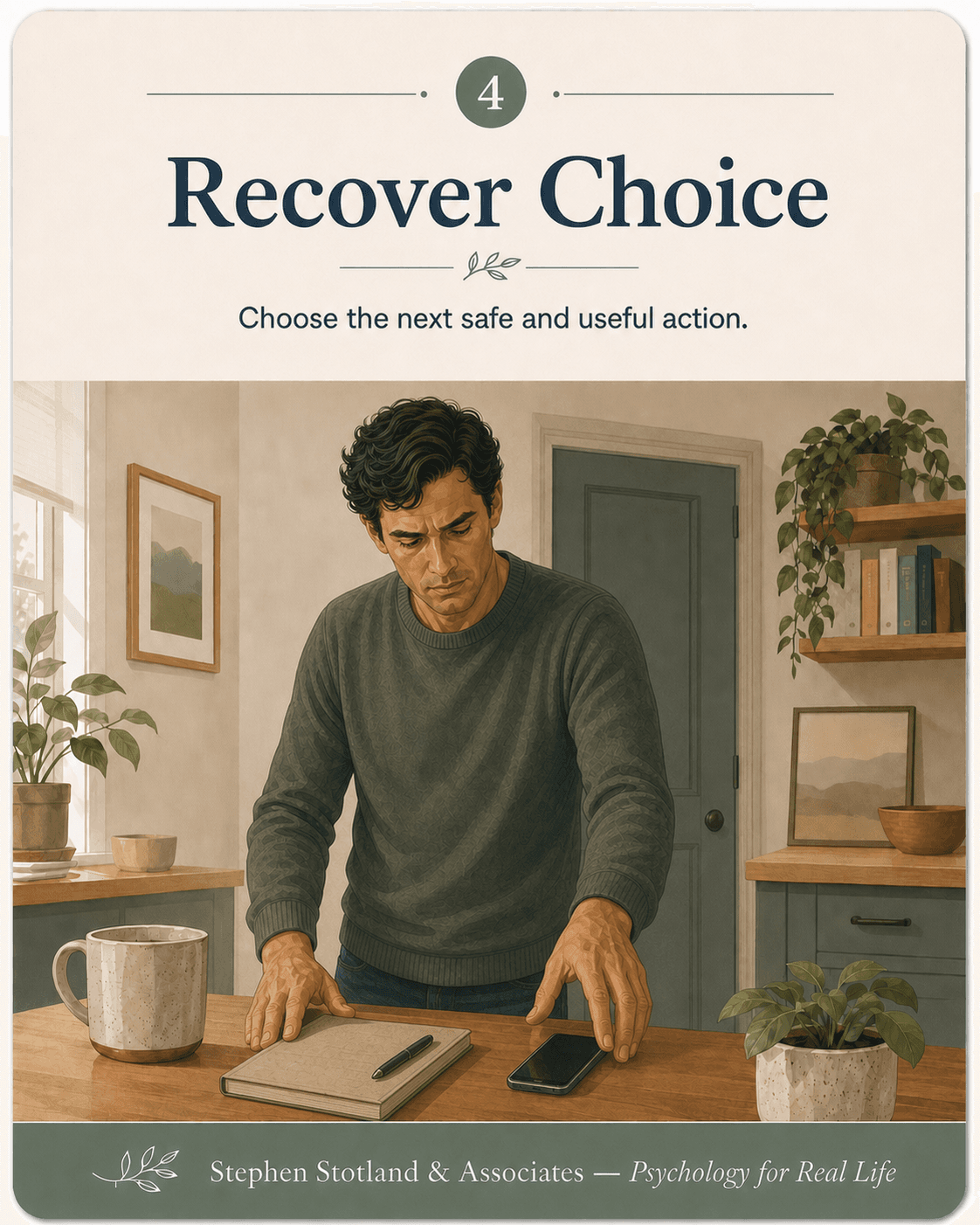
Recover Choice
Regain enough perspective to choose the next safe and useful action.
Choose one next action
What is the next safe and useful thing I can do?
Depending on the situation, you might:
- ask for support;
- move or use relaxation;
- create distance;
- eat, drink water, or rest;
- set a boundary;
- leave;
- delay an urge;
- continue with a constructive next step; or
- mindfully observe what remains.
You do not need to feel calm before you can make a useful choice.
If the state is still strong
Choose the smallest safe step: pause, contact someone, change the setting, or stay externally oriented. The best choice may be support, a boundary, leaving, or emergency help—not remaining in the situation.
Where this process may help
The same return can help during trauma-related activation, panic or acute anxiety, craving or strong urges, anger, shame, emotional storms, rumination, and worry. Use only what helps. In an intense moment, one reconnection action and one safe choice may be enough.
Returning, mindfulness, and relaxation
- Returning to the present
- Helps you reconnect when a strong state is taking over.
- Mindfulness
- Helps you observe an experience without being carried away by it.
- Relaxation
- Helps reduce unnecessary physical arousal.
When you are being pulled away from the present, first reconnect. When you can remain present without being overwhelmed, you may begin to observe the experience more openly.
Safety and flexibility
Keep your eyes open, use external sights and sounds, move, contact another person, or change settings when inward attention is destabilizing. Stop if disorientation or overwhelm increases. Respond to current danger or medical needs, ask for support, set a boundary, or leave when necessary.
Presence should help you become more oriented and connected, not less.
Personal practice support
The Personal Return Plan helps you prepare reliable ways to reconnect. The optional Practice Log can help you notice what worked and what support may be needed.